You are losing calls before the homeowner ever speaks to you, because your website, photos, and reviews do not make quick trust easy.
A lot of good contractors get passed over for a company with a cleaner Google profile, a few recent job photos, and a simple explanation of what they do. That has nothing to do with being the best crew on the block. It has to do with proof a homeowner can see fast.
Most people are not comparing skill first. They are comparing risk. They want to know if you show up, answer the phone, respect the property, and finish the job without drama. If your online presence feels thin or old, they assume the same thing about the business. That is the real problem.
What homeowners look for first
A homeowner usually decides in under a minute if you feel like a real business or a risky guess. They are not studying your whole story. They are checking for proof, clarity, and local signs that you actually work in their area.
The first thing they notice is simple: do you show real jobs? Fresh photos of a finished yard, a clean driveway, or a straight fence line matter more than fancy design. A phone shot from a jobsite is fine if it is clear and current. Old photos from three years ago do not help much.
They also look for signs you are easy to understand. What do you do, where do you work, and what kind of jobs do you take? If they have to guess, they move on. A homeowner wants to know if you handle a 12 by 14 foot patio, weekly mowing, drainage fixes, or full-yard cleanup before they waste time calling.
Local proof matters too. A business address, service area, local town names, and reviews that mention neighborhoods or job types all help. If you serve three counties, say that plainly. If you only work within 25 miles, say that too. That kind of honesty builds more trust than vague claims ever will.
Homeowners are not looking for perfect marketing. They are looking for signs that you show up, do the work, and belong in their area.
Reviews matter for the same reason. A few recent comments that mention the job, the crew, or how you handled the property are stronger than a pile of generic praise. If you want a better sense of what customer reviews really do, think of them as proof that another homeowner took the risk already.
If your site is thin, start with the basics. A clear service list, a real town or county, recent photos, and a few honest reviews can do a lot. That is the kind of a clear website for a landscaping business that helps a homeowner feel safe enough to call.
Key takeaways
- Show recent job photos that match the work homeowners actually hire you for.
- State your service area plainly, using towns, counties, and realistic travel limits.
- Use reviews that mention the job, the crew, and how you handled the property.

The online proof that earns calls
Homeowners do not need a fancy site. They need enough proof to feel safe calling you back.
The strongest signals are usually plain. Recent project photos, a clear service list, and a real service area do more work than a slick homepage with no substance. If you install patios, say so. If you handle drainage, mowing, pruning, or cleanup, list it in simple words.
Licensing and insurance details matter too, especially for bigger jobs or anything near a fence, driveway, or utility line. If your state or town requires a license number, show it. If you carry insurance, say that clearly. Homeowners are not trying to audit you. They just want to know you run a real business.
Job examples beat general claims. A short gallery with a 12 by 14 foot patio, a before-and-after lawn cleanup, or a retaining wall with a note about the soil or slope tells a better story than “quality work” ever will. Real work in real yards feels believable.
Reviews help for the same reason. A few recent ones that mention the job, the timing, or how you handled the property are stronger than a long list of vague praise. If you want a better breakdown of what customer reviews really do, think of them as a neighbor saying, “This crew showed up and handled it right.”
A homeowner will forgive a simple website. They will not forgive a site that makes them guess whether you are licensed, local, or even still in business.
Keep the details easy to scan:
- What you do.
- Where you work.
- What the job looked like before and after.
- How to reach you.
If your online presence only does one thing well, make it this: prove you are local, active, and worth a call. That is the kind of a clear website for a landscaping business that helps.
A simple comparison of trust signals
Homeowners are not comparing your site to a marketing brochure. They are comparing it to the next contractor in the search results.
That means weak signals stand out fast. A stock photo of a green lawn, no town names, and a contact form with no phone number makes people hesitate. It feels vague. And vague usually means they keep looking.
Strong signals are plain and specific. A real photo of a patio you built, a short service area, and a license or insurance note, if you carry it, make the decision easier. Easy is good. People call the business that feels straightforward.
Reviews work the same way. A handful of recent reviews that mention the job, the crew, or the neighborhood carry more weight than a long list of generic praise. If you want a better sense of what customer reviews really do, think of them as proof that someone else already took the risk.
Here is the basic difference:
- Weak: “We do it all” with no details. Strong: “Patios, drainage, mowing, and cleanup in your county.”
- Weak: old gallery photos from years ago. Strong: recent job photos with a clear before and after.
- Weak: no location, no phone number, no license info. Strong: real contact details and a service area that matches where you work.
- Weak: one-line reviews like “Great job.” Strong: reviews that mention timing, communication, and the finished work.
A homeowner does not need a perfect website. They need enough proof to stop worrying that calling you will waste their time.
That is why a simple, honest site often beats a busy one. If the details are clear, the homeowner can move from doubt to action without a lot of thinking. A a clear website for a landscaping business does not need tricks. It needs proof people can scan in a few seconds.
| Option | Typical cost | Best for |
|---|---|---|
| Stock photos and vague service copy | $0 to $500 | Looking polished at a glance, but weak on trust |
| Basic site with real job photos and service area | $500 to $2,500 | Getting more calls from local homeowners |
| Site with reviews, license info, and clear contact details | $1,500 to $5,000 | Building stronger reassurance for bigger jobs |
| Thin site with no updates for years | Low upfront, high lost leads | Nothing useful, because it makes people hesitate |
What to fix before you spend more
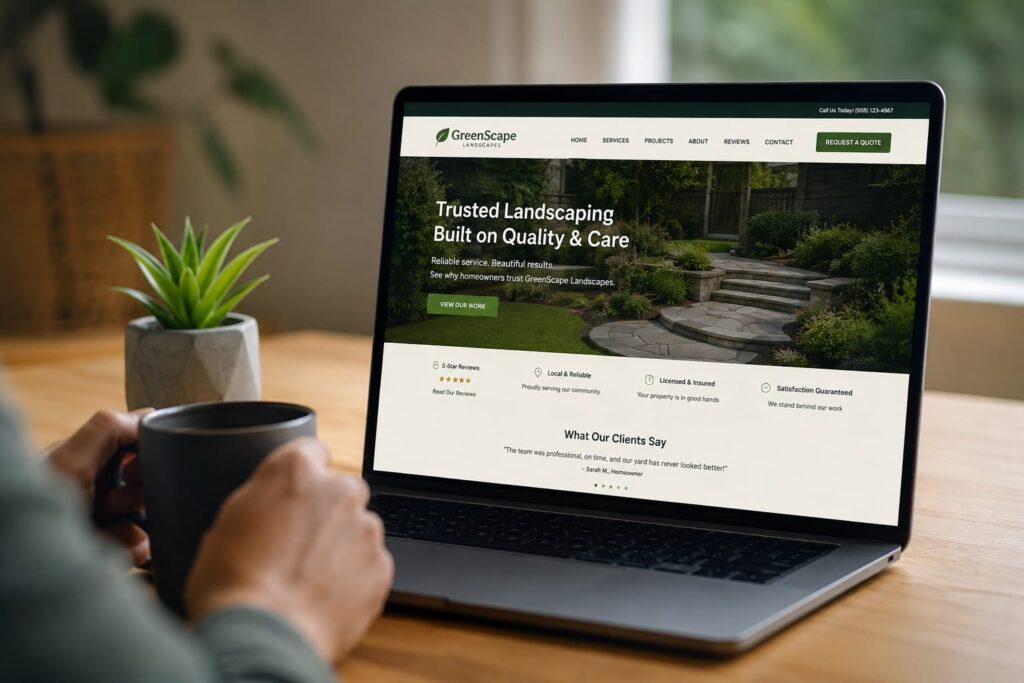
If your site is thin or out of date, do the small fixes first. They usually matter more than a full redesign. A homeowner just wants to know you are real, local, and easy to reach.
Start with the first thing they see on a phone. Put your service area, your main phone number, and one clear line about what you do near the top. If you work in a few counties, say that. If you only take certain jobs, say that too. Guessing kills calls.
Then clean up the proof. Swap out old gallery shots for a few recent job photos, even if they are just taken on a jobsite with decent light. Add one or two short notes about the work, like a drainage fix after a heavy rain or a patio rebuild after frost heave. That is the kind of detail people remember.
After that, fix the trust basics:
- Make sure your phone number is visible on every page.
- List your town or service area in plain English.
- Add license and insurance info if you carry it.
- Update your hours so people do not call a dead line.
- Show one recent review if you have it, since what customer reviews really do is reduce hesitation.
Do not spend money polishing sections nobody reads. A fancy homepage cannot make up for missing basics. A plain page with real photos and a working phone number will usually beat a prettier site that leaves people guessing. That is also part of being easier to find online.
A homeowner does not call the contractor with the best design. They call the one they understand fastest, and the one that looks like it still does the work it says it does.
From the field
Most homeowners are not judging craftsmanship from a website. They are deciding whether they understand your business in a few seconds. If they can tell what you do, where you work, and what kind of job they can expect, they keep going. If they have to hunt for that answer, they move on to the next contractor. A clean page with real photos and a clear service area usually does better than a polished site that hides the basics.
Make first contact feel easy
If a homeowner has to work to reach you, you lose the call. Phone, text, and your contact form should all feel simple, clear, and safe to use.
Your phone number should be easy to find on mobile without pinching and zooming. Put it in the header, again near the bottom, and make sure it actually rings somewhere you answer. If you use voicemail, keep it professional and brief. A long, messy greeting makes people wonder if you are too busy to call back.
Text matters too, especially for homeowners who are at work or managing kids. If you can text, say so. A short line like Text us photos for a faster estimate does more than a paragraph of sales copy. It tells people how to start, and that you are comfortable using the way they already communicate.
Your contact form should ask for only what you need to respond well. Name, phone, address or town, and a short message is enough for most jobs. If the form looks like a loan application, people back out. No one wants homework before a callback.
One more thing. Set expectations. A simple note like “We return calls within one business day” or “Texts answered during business hours” reduces anxiety fast. That kind of plain language works better than vague promises, and it supports what customer reviews really do, which is show people you follow through.
The first contact should answer three questions right away, can I reach you, will you respond, and do you sound like someone I want in my yard or on my roof?
- Use one main phone number and make it visible on every page.
- Offer text if you can answer it during business hours.
- Keep the form short and do not ask for details you do not need yet.
- Say when people can expect a reply.
That is the whole job here. Reduce friction, remove doubt, and make the next step feel normal. For many contractors, that simple setup does more than a redesign, and it fits with contractor growth and local visibility without adding a lot of moving parts.
Common trust questions homeowners ask
Homeowners ask trust questions because they want to know who is real and who is trying to sell them hard. That same instinct shows up online. A contractor with clear photos, a working phone number, and plain answers feels safer than a site full of vague promises. Trust is usually built in seconds, then confirmed by small details.
For a contractor, the lesson is simple. Show the job, show the area you serve, and show how to reach you. People do not need a fancy story. They need enough proof to believe you will show up, do the work, and answer the phone if something goes sideways.
Most homeowners are not looking for perfect. They are looking for signs that you are steady, local, and not hiding the basics.
What is the downside of putting your house in a trust?
The main downside is cost and paperwork, plus the chance of doing it wrong if the deed and trust documents do not match. A trust can also make refinancing or insurance updates more annoying if the title was not handled cleanly. For contractors, that is a good reminder that trust comes from clear setup, not just a nice-looking page.
What is the fastest way to build trust?
The fastest way is to show real proof right away. Use recent job photos, a local service area, a working phone number, and one or two plain reviews. People move faster when they do not have to guess. Clear beats clever every time, especially on a phone screen.
Can I put my house in a trust without a lawyer?
Sometimes, yes, but it depends on your state and how simple your situation is. A basic trust can be set up without a lawyer, yet many homeowners still use one to avoid title mistakes, tax issues, or probate problems later. If the paperwork is off, the trust may not do what you thought it would.
What does it cost to put your property into a trust?
Costs vary a lot. A simple do-it-yourself setup may cost a few hundred dollars in filing and document fees, while attorney help can run from about $1,000 to $3,000 or more, depending on the state and complexity. The price usually goes up if you have multiple properties or want broader estate planning.
Why does trust matter so much before someone calls?
Because a homeowner is taking a risk by inviting you onto their property and spending real money. If your online presence looks current, local, and straightforward, the call feels easier. If it looks abandoned, people assume the same about the business. That is often the whole decision.